

“How can I grow spiritually?” Every pastor has heard this question, and every earnest believer has asked it. It’s such a good question. It recognizes that there is an organic aspect of the Christian life. Just as our natural lives have multiple stages of development and maturity, so our spiritual lives begin with our new birth and we develop and mature over time. Unfortunately, much of the church has lost sight of the means of growth that the Lord has given to His people for their spiritual life, drifting to a focus on what we do rather than what God does in, for, to, and through us. While the historical Reformed approach to spiritual growth has been through the means of grace, the modern church has shifted its emphasis to “spiritual disciplines”, and in the process, moved from a focus on God’s work to a list of activities we must do. My contention, along with the historical Reformed tradition, is that growth in faith is fueled not through spiritual disciplines but through the means of grace.
Spiritual Disciplines Defined
For many people, the concept of “spiritual disciplines” came onto their radar through the work of Dallas Willard. His work emphasized the individual Christian’s personal and private activity and tied his expectation for someone’s spiritual growth to his consistency in practicing these habits. The spiritual disciplines as conceived in this framework include things like solitude, silence, fasting, frugality, chastity, secrecy, sacrifice, study, worship, celebration, service, prayer, fellowship, confession, and submission. Spiritual disciplines are activities or habits that, when consistently practiced over time, are intended to achieve spiritual formation. The promise is that if a Christian faithfully practices these disciplines, he will ultimately find himself looking more and more like Jesus. This approach was picked up by John Mark Comer in his very popular book Practicing the Way. In fact, the category of “spiritual discipline” is virtually limitless. Comer himself writes “Anything can become a spiritual discipline if we offer it to God as a channel of grace” (Practicing the Way, page 179). Comer’s way leads us into the timeless conundrum that if everything is special, then nothing is special.
Yet it can be difficult to find fault on the surface. Are these not all good things? Who would be against chastity, sacrifice, service, and worship? Doesn’t Jesus Himself model and teach us solitude, fasting, prayer, and submission? The problem is that although many of these are good things that Christians ought to intentionally participate in, to see these spiritual disciplines as means for spiritual growth is to make a category error. These are largely private, not communal; they are inwardly focused rather than outwardly focused; and they are centered on doing rather than receiving. To the hammer, everything looks like a nail; to the mystic, everything looks like a channel to God; and to the legalist, everything looks like a command. But there is a more excellent way.
The Means of Grace Defined
The historic Reformed approach to spiritual growth—while never diminishing calls to evangelical obedience—instead hinges on the gifts of God for the people of God. In fact, all the Reformation church traditions saw the necessity of breaking from the medieval Roman church’s system of merit-based salvation in a return to salvation by grace from first to last. Acts 2:41-47 is a classic framework for the activities the early church (and the Reformation churches) saw as the essential core of Christian discipleship:
So those who received his word were baptized, and there were added that day about three thousand souls. And they devoted themselves to the apostles’ teaching and the fellowship, to the breaking of bread and the prayers. And awe came upon every soul, and many wonders and signs were being done through the apostles. And all who believed were together and had all things in common. And they were selling their possessions and belongings and distributing the proceeds to all, as any had need. And day by day, attending the temple together and breaking bread in their homes, they received their food with glad and generous hearts, praising God and having favor with all the people. And the Lord added to their number day by day those who were being saved.
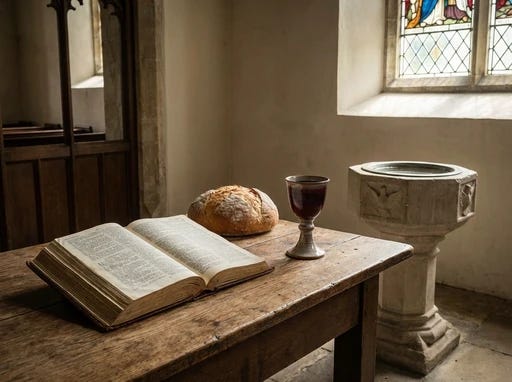
The means of grace that the first converts at Pentecost practiced under the direction of the apostles were: the Word (the apostles’ teaching), the sacraments (baptized…the breaking of bread – likely a reference to the Lord’s Supper), prayer (interestingly the prayers – possibly a reference to praying the Psalms, the Lord’s Prayer, or other forms in corporate prayer), and fellowship. These means were the focus in the context of gathered worship (attending the temple together…praising God) as well as private gatherings (in their homes). Of central importance is that the believers’ devotion—the center of their life together—were these four means: Word, sacrament, prayer, and fellowship. And it is out of these means that their love for their Lord overflowed into love for one another and the world displayed through generosity, meeting each others’ needs, evangelism, and hospitality. These believers did not think that just anything could be a channel to God. They didn’t utilize the still-intact Old Covenant sacrificial system. They didn’t withdraw from each other into silent retreats for contemplation. Their approach to spiritual formation was largely communal and externally focused. They devoted themselves to those things that God gives and promises to use for the benefit of His children; things to be received, not works to be done. Which brings us to the core theological and philosophical distinction.
Law/Gospel Distinction
The historic Reformed faith has a healthy appreciation for the distinction between God’s law and His gospel. God’s law tells man what he is to do, while the gospel tells him what God has done and promises to do for him. This distinction is beautifully summed up in a poem attributed to John Berridge, where he writes:
“Run, John, run” the law commands,
Yet gives me neither feet nor hands;
But sweeter news the gospel brings;
It bids me fly, and lends me wings.
In contrast, the modern spiritual discipline approach to spiritual formation is just warmed-over Wesleyan pietism with a sprinkle of Christian mysticism (which is itself simply a repackaged form of the very works-based spirituality that caused the need for Reformation in the first place). It says “if you really want to become more like Jesus, you must do all these things, and only then will God grant you the growth you deserve”. It can only result as all works-righteousness systems do in one of two ends: either pride in thinking that I am the superlative Christian who has achieved a higher level of spirituality through the disciplines I practice, or else in pitiful despair in realizing how far short I fall in my efforts to grow myself. Framing this approach in the context of grace or mystical encounters with God cannot change the fact that the impetus in the entire framework is the individual Christian’s efforts, and success rises or falls on the level of his obedience.
The Reformed approach, however, is not based on the law, but on the gospel. The means of grace are not means of law. They are channels ordained by God for Him to communicate the gift of His unmerited favor for spiritual sustenance to bring about the spiritual growth He desires in His people. It is not through doing but through receiving that the Christian grows. For what is the Word—even when the law is read or preached—but a means of grace, as God speaks by His Spirit to His people to confront them in their sin, to call them to repentance, to guide them in obedience, to grant wisdom for their future, to assure them in their doubting, to comfort them in their mourning, to strengthen them in their weakness, and to establish them in their difficulties? What are the sacraments if they are not constant reminders of God’s unmerited favor through Christ, signs and seals of the covenant of grace (not law!), communication of all the benefits He gives through that covenant, and consistent renewal of Christians’ engagement and responsibility to live as the holy subjects of their King? What is prayer if it is not an offering up of thanks along with desires and petitions, by which Christians’ wills are conformed to God’s perfect will (not the other way around) and He eagerly grants what is asked as a gracious and generous Father? And what is fellowship if not the instrument for Christians to mutually exhort, admonish, and encourage one another; to bear each other’s burdens; and to stand firm together on the foundation of the gospel promise of God? The law of God brings with it no power for the Christian to obey it, but through the gospel and these means of grace, Christians are formed by God’s grace into the image of their Savior and empowered by the Holy Spirit to greater obedience with confession and repentance along with mortification of their sins. Because ultimately, spiritual growth is just another term for sanctification.
Sanctification
And thanks to our Larger Catechism, we know that
Sanctification is a work of God’s grace, whereby they whom God hath, before the foundation of the world, chosen to be holy, are in time, through the powerful operation of his Spirit applying the death and resurrection of Christ unto them, renewed in their whole man after the image of God; having the seeds of repentance unto life, and all other saving graces, put into their hearts, and those graces so stirred up, increased, and strengthened, as that they more and more die unto sin, and rise unto newness of life.
- Westminster Larger Catechism, Answer 75
The Reformed are not quietists; we do not “let go and let God” as in Keswick theology. But we recognize that sanctification is a part of the ordo salutis (the order of salvation), and so just as we are justified and adopted by grace through faith, we also are sanctified by grace through faith. Sanctification is a work, which means that unlike justification and adoption, it is not an instantaneous act of God. No, it has pleased our covenant Lord that sanctification be an ongoing process, which at times may feel infinitesimally small and slow. But it is His work, which means that it cannot fail. We work out [our] own salvation with fear and trembling, but not through self-empowered ways of discipline, for it is God who works in you, both to will and to work for His good pleasure (Philippians 2:12b-13). And I am sure of this, that he who began a good work in you will bring it to completion at the day of Jesus Christ (Philippians 1:6).
Conclusion
So, to come back to the beginning: “How can I grow spiritually?” Well, you could try the way of jumping on the treadmill of extrabiblical spiritual disciplines, trusting your own will power to eventually overcome your flesh so that you form yourself into the image of Jesus. Or, you could take every opportunity to avail yourself of God’s means of grace, the tools in the toolbox of His ministers and His children which the Holy Spirit loves to use to achieve His purposes. You could join and faithfully attend a church where week in and week out you hear the full counsel of God’s word read and preached, participate in the sacraments, spend extended time in corporate prayer, and fellowship with other believers. Christian sanctification might be more than, but is certainly not less than, sitting under the simple means of God’s grace in weekly Lord’s Day worship. To further experience growth, you could in your own home have times of family and personal devotion where you read God’s Word, offer prayers of thanksgiving and petition along with confession and repentance, and you could invite other Christians to join with you. You could talk to your pastor or elders or a more mature believer and ask them for wisdom and guidance on how you could make the best use of these means God has given. And if you trust God’s work through His means to achieve His purposes, regardless of how little you might feel it day-by-day, you will grow and produce spiritual fruit, and you will come to know the promise:
Now may the God of peace himself sanctify you completely, and may your whole spirit and soul and body be kept blameless at the coming of our Lord Jesus Christ. He who calls you is faithful; he will surely do it.
- 1 Thessalonians 5:23-24