

In the 1800s, an American revivalist movement gave rise to the motto: “no book but the Bible, no creed but Christ.” On its face, this seems like a well-intentioned attempt to keep Jesus and His word central to the Christian life, and it seems to be fair to say that this statement captures the ethos of a large part of the church in the Ozarks. But five seconds’ thought shows the weakness of this philosophy. Just start with simple questions like “which Bible – the one held to by Protestants or Roman Catholics?” Or “which Jesus – the truly man, truly God only-begotten Son of the Father confessed by the Christian church throughout history or the spirit brother of Lucifer confessed by Mormonism?” Or more simply “do you believe that statement (no book but the Bible, no creed but Christ) is true?” If so, congratulations, you have affirmed a creed (from Latin credo – meaning “I believe”)! And you have done so by affirming words that are not directly from Scripture themselves.
Confessional Impetus
Scripture clearly teaches that Jesus Christ is truly God, being the Son of God from all eternity (John 1:1-4, 1 John 5:20, Philippians 2:5-6). It also clearly teaches that Jesus Christ is truly man (John 1:14, Hebrews 2:14-17, Philippians 2:7-8). Yet to understand how both of those claims are true at the same time, we must look at what the entirety of Scripture says on the subject in a systematic way and summarize Scripture’s teaching. It was not until Arius arrived on the scene spreading his jingles denying the Son’s eternal nature that the church came together to formulate their response. Based on Scripture, they produced the Nicene creed to contend for the faith once for all delivered for the saints against the blasphemous heresy perpetuated by Arius and his followers.
Words have meaning, and from the time of our first parents in the garden, God’s word has been challenged. Any time we explain, clarify, or contrast what we believe the Bible to teach – especially in distinction from the teaching of others – we are doing creedal or confessional work. Confessions, like Thanos in the Marvel multiverse, are inevitable.
The question then is whether it is necessary or wise for each individual Christian or congregation to develop a unique summary of Christian doctrine apart from what Christians have held in centuries past. This is certainly a common approach in American evangelicalism. Visit the website of any of the upstart church plants in your area, and you will likely find a brief statement of faith with 10-12 summary statements of the doctrines most important to its leader(s). My contention is that this constant reinventing of the wheel is not only unnecessary but also deficient to provide a firm foundation of Scriptural truth on which to stand in an unstable world.
Further, it belies a latent arrogance akin to what C.S. Lewis called “chronological snobbery” to conclude that we are the insightful and pure heroes God has been waiting for to finally explain the Christian faith better than saints from the past 2 millennia. Or to think about it a different way, if you were asked “what does your church believe about x”, how would you respond? You could refer to the brief statement of faith meant to build the broadest possible consensus. But what if the matter isn’t addressed in that document? Or what if the leader(s) of the church change his/their mind(s)? Conversely, perhaps you could explain that your church’s beliefs are found in the sacred pages of Scripture and work from Genesis to Revelation, covering every passage that touches on the topic at hand. But when professing followers of Christ can be found on every side of every debatable question, what is the method to draw the line between what is essential Christian doctrine and what matters can be disagreed upon without breaking fellowship? How do we tell the difference between core tenets of the Christian faith and things The Dude would designate as “yeah, well, you know, that’s just like your opinion, man”? After all, every heretic in church history began with an inductive Bible study where his novel false understanding flew in the face of the church’s explanation of God’s word. Creeds and confessions are well-thought, hard-fought summaries of what the Bible says, often formed in the midst of controversy to elaborate the truth and correct error. Abandoning these gifts provided through the providence of God is a fool’s errand.
Confessional Imperative
The Bible itself encourages the use of summary statements of doctrine. Moses taught the people of Israel to hear “the Lord our God, the Lord is one” (Deuteronomy 6:4). The apostle Paul scattered 5 “faithful sayings” through his letters to young pastors Timothy and Titus. In the opinion of many scholars, Philippians 2:6-10 is an early hymn or creed well-known in the apostolic churches. Jude charged his readers to “contend for the faith once for all delivered to the saints” (Jude 3). How were they to know what this faith was? And how would they recognize that others were contradicting it? They would need summary statements encapsulating the apostolic teaching.
Which brings us to an important warning. The Protestant – indeed the historic Christian – view is that creeds and confessions are not binding when they contradict or go beyond Scripture. They are not Holy Spirit inspired. They are not inerrant nor infallible. They are correct and binding only insofar as they conform to and explain the holy, inspired, inerrant, infallible word of God contained in the Scriptures of the Old and New Testaments. Reformed Christians do not hold to solo Scriptura, but we do hold to sola Scriptura. We have a healthy appreciation for and acceptance of tradition, but the final measure of faith and practice is what is expressly written in or deduced by good and necessary consequence from Scripture. While the Christian faith is founded on Scripture as our sole final authority, the historical creeds and confessions are guardrails that prevent us from running on ahead and plunging headlong into error or apostasy based on our own faulty interpretations of God’s word.
Confessional Identity
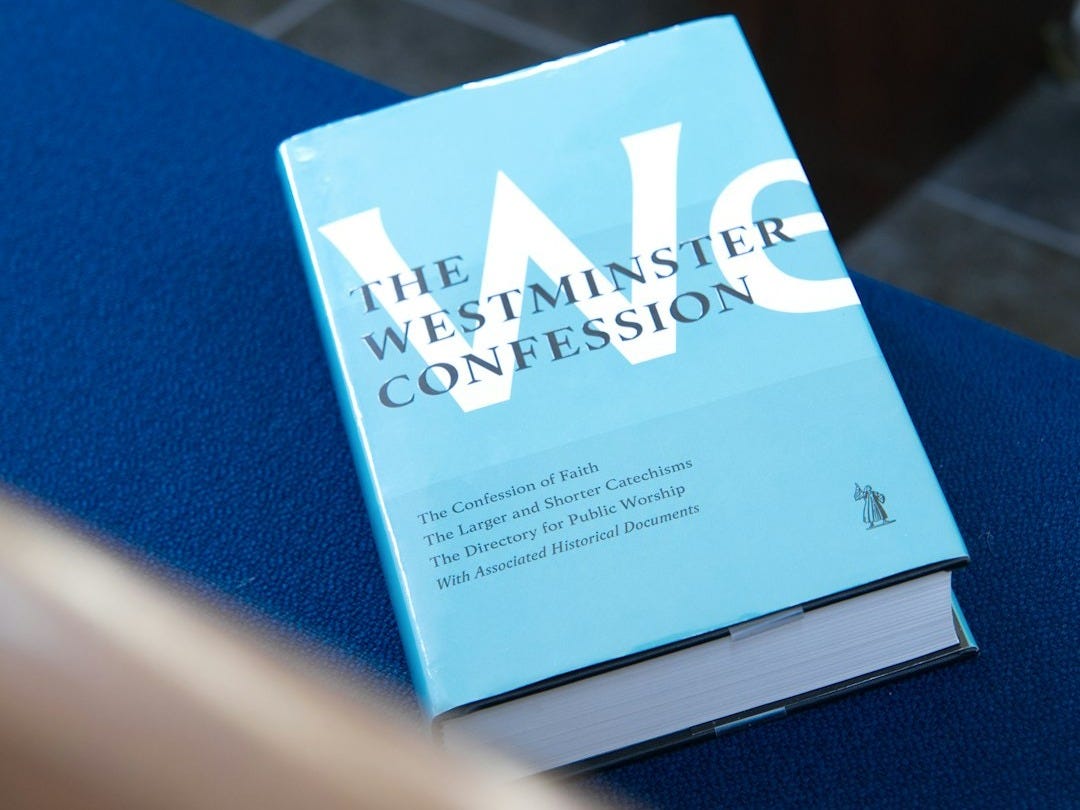
Our project is called Reforming the Ozarks, and we are unabashedly Reformed Christians. The three of us, being pastors in the Presbyterian Church in America, have taken vows that the Westminster Confession and Catechisms are our own confessions of what we believe Scripture to teach. We are convinced that the Reformed and Presbyterian understanding of Scripture is the most faithful system of doctrine written to summarize the truths of the Bible. And this identity moves us beyond bare mental assent to doctrinal truths. It carries as a natural outworking distinctively Reformed Christian piety and practice. Reformed churches are constrained by our understanding of Scripture to worship God according to the regulative principle, only doing in corporate worship what God has given in His word by command or positive example. We emphasize the means of grace that God in His word has promised to bless; namely, the ministry of the word – especially its preaching, the sacraments of baptism and the Lord’s Supper, prayer, the proper exercise of church discipline, and warm Christian fellowship.
And a confessionally Reformed identity will shape the Christian lives of individual believers. It will drive us constantly back to the Lord Jesus Christ as our only hope in life and in death. It will strengthen our assurance of salvation and God’s love through our Spirit-wrought union with Christ through faith for every bit of our salvation: justification, adoption, sanctification, and glorification. Our confessional Reformed identity will lead us to both pursue righteousness by seeking to conform our lives to God’s moral law as summarily expressed in the Ten Commandments and to refrain from passing judgment on our brothers and sisters in matters of Christian liberty.
This identity will (or it at least should) return us over and over again to the pages of Scripture, which the confessions and creeds seek to elucidate. Semper reformanda is the motto of the constant submission of our churches, our minds, our hearts, and our hands to the only infallible rule of faith and practice: God’s holy word. We want to see the Ozarks reformed because we are convinced that this will most fully express God’s revealed will for our neighbors. So, tolle lege, take up and read. Open up the ancient creeds and the historic confessions in one hand and your Bible in the other, and join us in our prayer that our neck of the woods would be reformed by God’s word.