

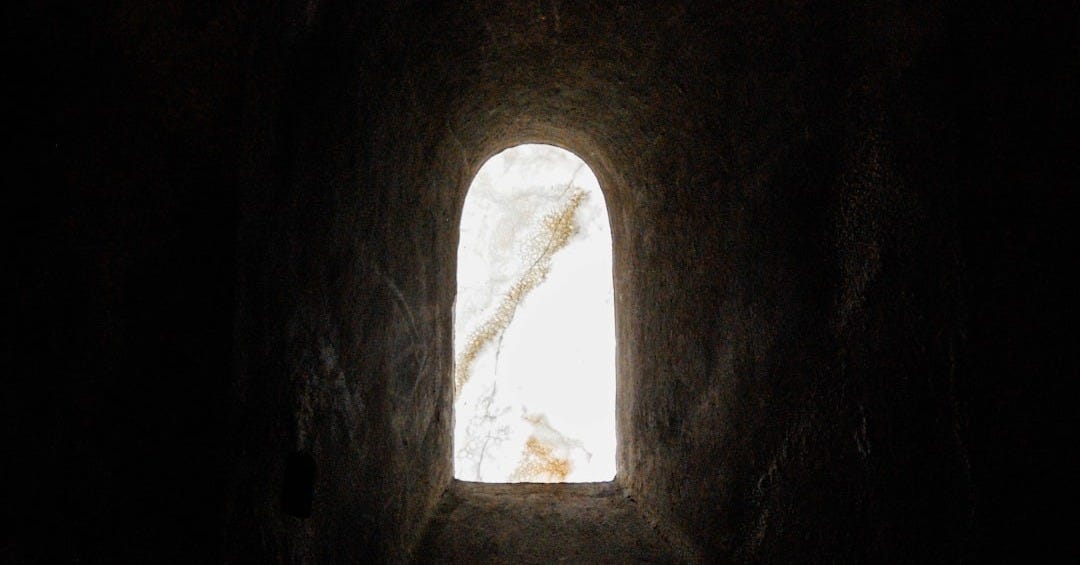
Good Friday is a solemn occasion for remembering and reflecting on Christ’s crucifixion, death, and burial. For good reason, many services will focus primarily on what his death on the cross accomplished—a substitutionary sacrifice to satisfy the divine justice of God against our sin.
What is sometimes looked over is the simple fact that Jesus, the Lord of life, was also buried. Each gospel records the event when Joseph of Arimathea asked for the Lord’s body and buried him in a tomb. When we confess the Apostles’ Creed, we confess not only that he was crucified and died, but also that he was buried.
We understand the importance of his sacrificial death on the cross. But why is his burial important to remember? And what benefit do we receive from it? In his exposition of the Heidelberg Catechism, Zacharius Ursinus provides several reasons why it was necessary that Christ was also buried.1 In this article, I want to compile and summarize his notes and offer five reasons why Christ’s tomb is a great comfort to us.
First, Christ’s burial makes certain that he truly died. If his death is for our atonement without which we have no forgiveness of sins, then how great a benefit is it that we are certain of his sacrificial death? The tomb proves that for us.
In the same way that after his resurrection he made himself known to his disciples when he was seen and touched by them, so also at his death his lifeless corpse was wrapped in linen, carried to the tomb and laid there. As Ursinus writes, “We are, therefore, by his burial, assured that he was really dead, and by this of our certain redemption; for our salvation consists in his death, the proof of which is his burial.”2
Second, Christ’s burial proves that he has borne our curse to the fullest extent. By his suffering even unto this last part of his humiliation, we know that he has truly left nothing undone and was able to cry out in truth: “It is finished” (John 19:30).
When God first made man, after he put him in the garden he said to him, “You may surely eat of every tree of the garden, but of the tree of the knowledge of good and evil you shall not eat, for in the day that you eat of it you shall surely die” (Gen. 2:16-17). We know the tragic story of Adam’s sin and rebellion in eating that which God had forbidden. Thus, we read in the next chapter of Genesis that the curse threatened was now in fact placed upon him: “for you are dust, and to dust you shall return” (Gen. 3:19).
This is the curse that we were to suffer for sin—the curse of pain of death. Yet Christ bore the full weight of the curse on our behalf, and demonstrated it to us by being buried in the tomb and remaining in the state of death until the third day, “for he was not unwilling to become a corpse for our sake.”3 Rather, he willingly, with joy, endured the cross and the full extent of the curse on our behalf (Heb. 12:2). The tomb proves that this is true.
Third, his burial in the tomb gives us all the more reason to have confidence in the resurrection. When Joseph of Arimathea asked Pilate for Jesus’ body, all the gospel writers except for Mark use the generic term for body. Mark, however, uses the more specific term for a lifeless body. That is, a “corpse” (Mark 15:45).
It was a dead and lifeless body that was taken down from the cross on that Good Friday. It was the same lifeless corpse of the Lord of Glory that was wrapped and buried. And it was the same corpse, the same flesh and bones, that was resurrected on that glorious Sunday. Breath filled his lungs once again as he ushered in the new creation—the first fruits of the dead.
This point is vital because it shows us that Christ has really defeated death. He didn’t take the easy way out. He didn’t shrink back at the last minute. He took it all. He died. And he was buried. George Bethune captures the importance of this moment poetically when he writes,
“What a night was that when the stars looked down on the world, whose Saviour and Lord lay dead and buried. Think of the poor disciples, shrunk into hiding-places like [fearful] sheep whose shepherd is slain, and of the broken-hearted women, loving without hope, but faithful in their despair! Yet the sufferer is at rest. He sleeps. His labors are done, his pains are past, his enemies have accomplished their worst; his last cry was the escape of his spirit, and his dear, holy, mangled flesh awaits in peace a speedy awakening far beyond sorrow and [shame], within the glory of his better world, where all the heavenly host will acclaim him an infinite [praise], because the signatures of the cross attest him the Lamb that was slain. Odors, fragrant and rich, fill the air, as the spices breathe their honors around him, and the flowers of the garden are [fragrant] through the dews. All is as sweet as it is calm. Faithful Master, thanks be to thee, that thou didst not refuse to lie down in the grave!”4
Christ did not refuse the grave, but he laid down his very life so that his lifeless body would lay in the tomb.
Fourth, Christ’s burial in the tomb thus sanctifies the grave and removes the fear of death and burial from us. Zacharias Ursinus puts it this way, “...he has sanctified our graves by his own burial, so that they are no longer graves to us, but chambers and resting places in which we may quietly and peacefully repose until we are again raised to life.”5
Jesus’ burial proves the words of Psalm 118:15 are true, “Precious in the sight of the Lord is the death of his saints.” Many of us have buried loved ones. If our Lord tarries, our loved ones will also bury us one day. What a comfort is it, then, that our death is precious in his sight. And we know it is, because God sent his own Son to die and be buried as we all must be.
On this great comfort, Dr. Guy Waters writes in a recent book on facing death, “Now that we are in Christ and share in His death, we stand in an entirely new relationship to death. Why do believers no longer fear death? It is because it cannot do us harm.”6
Which leads to the final reason for comfort.
Fifth, his burial brings us great comfort in knowing that our graves can no more hold us than Christ’s was able to hold him. As Paul tells us “Just as we have borne the image of the man of dust, we shall also bear the image of the man of heaven” (1 Cor. 15:49). Therefore, he goes on to conclude: “Death is swallowed up in victory. O death, where is your victory? O death, where is your sting?” (1 Cor. 15:54-55).
This is the great hope of our Christian faith: the grave is not the end. Our graves confirm to us this comforting truth—that we share in the burial of Christ, and like Christ we too will be raised in glory.
As the Pharisees set a guard around Christ’s tomb in vain, Christ sets his guard around the graves of his saints. He sets his own seal on the grave, declaring “This one is mine!” And on that day when he returns, in the same power that rolled away the stone, he will open up the graves of his people and bring them forth immortal and incorruptible. Without tears, without sin, with pain, without sorrow. In this great comfort our fear of the grave is destroyed. Christ has gone before.
Thus the hymn goes,
I would not live always; no, welcome the tomb:
Since Jesus hath lain there, I dread not its gloom.
There sweet be my rest till He bid me arise
To hail Him in triumph descending the skies.7
As we reflect and meditate upon Christ’s once for all sacrifice of his death on the cross, let us not forget that he was also buried and so remained in the grave three days. In this we have great confidence. The grave could not hold him; neither shall it hold us.
Zacharias Ursinus, The Commentary of Dr. Zacharias Ursinus on the Heidelberg Catechism, trans. George W. Williard (Grand Rapids: Reformed Free Publishing Association, 2025), 223-224. Heidelberg Catechism Question 41 asks, “Why was he also ‘buried’?” Answer, “Thereby to prove that he was really dead.”
Ursinus, Commentary on the Heidelberg Catechism, 223.
Ursinus, Commentary on the Heidelberg Catechism, 224.
George W. Bethune, Guilt, Grace and Gratitude: Lectures on the Heidelberg Catechism, vol. 1 (Edinburgh: Banner of Truth Trust, 2001), 384.
Ursinus, Commentary on the Heidelberg Catechism, 224.
Guy Prentiss Waters, Facing the Last Enemy: Death and the Christian (Sanford, FL: Ligonier Ministries, 2023), 39.
William Augustus Muhlenberg, “I Would Not Live Alway” (1824), verse 3.