

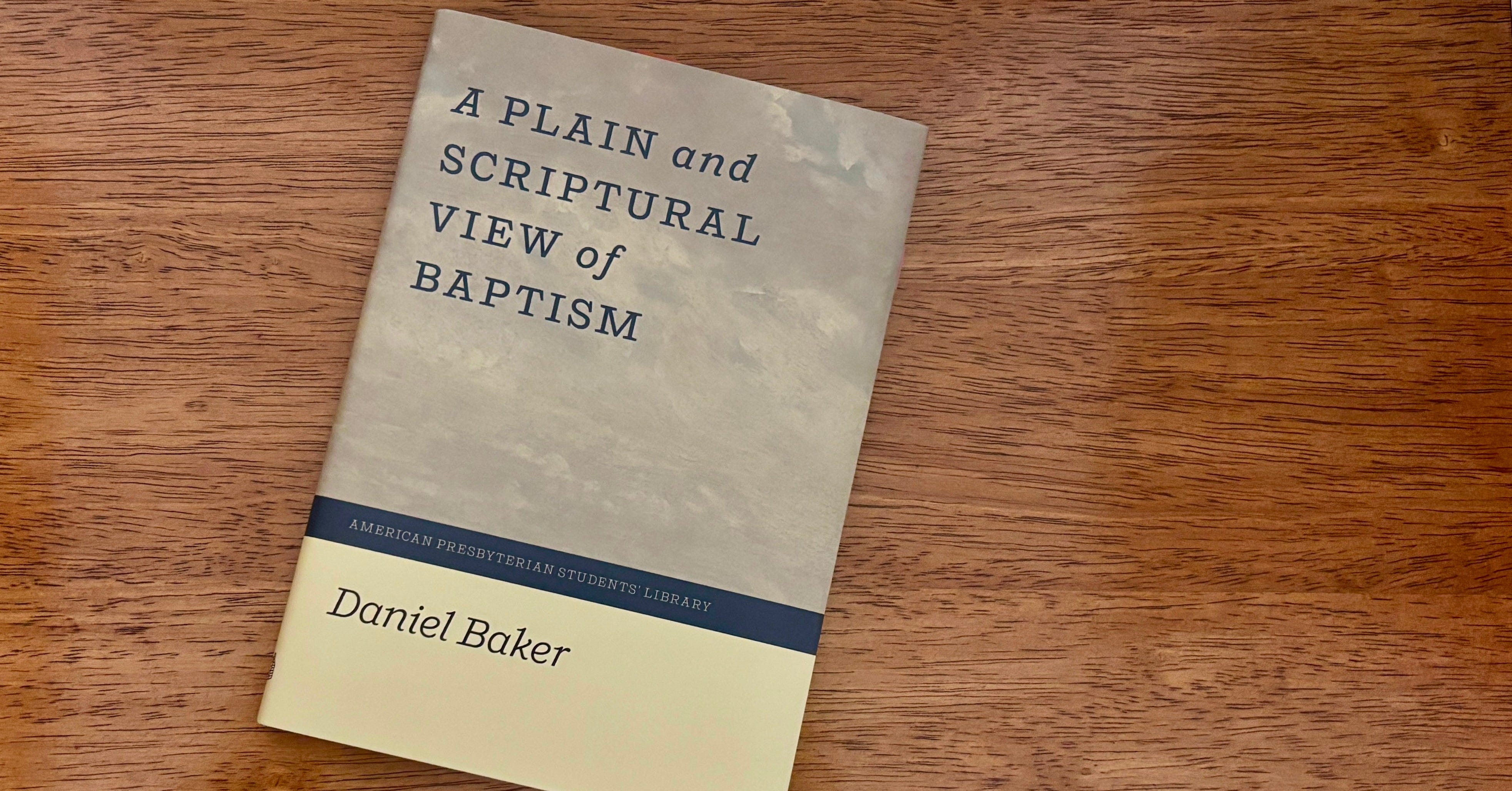
Thanks to the Log College Press, Daniel Baker’s A Plain and Scriptural View of Baptism has been reprinted in an accessible format. Reverend Baker was an influential Presbyterian minister and evangelist in nineteenth century America. This work on baptism was first published in 1853 and remains one of the best introductions to the topic today. If you are interested in learning more about the Presbyterian and Reformed view of baptism, this is a must read.
Baker packs a lot of information into only 73 pages. After a brief preface describing the necessity of this short volume, he divides his work into two sections, the proper subjects (or recipients) of baptism and the proper mode of baptism.
These two topics, the recipients and the mode of baptism, continue to be the primary dividing lines between different beliefs regarding the sacrament. Presbyterians affirm the proper recipients of baptism are not only believers but also their children (WCF 28.4). Likewise, we affirm that immersion is not the only valid (and therefore necessary) mode, but that baptism is “rightly administered by pouring or sprinkling water upon the person” (WCF 28.3).
These positions put us at odds with the majority of churches and believers in our area today. The following is a summary of the main arguments that Baker goes through in his book. In this article, I will only touch on the first part regarding the proper recipients of baptism. In another post I will consider the second part in which he discusses the proper mode. I hope that these introductory articles will provide understanding of the biblical reasoning behind our beliefs about baptism, and encourage readers to pick up A Plain and Scriptural View of Baptism for themselves.
The Subjects of Baptism
The author begins his treatment on the proper subjects of baptism by stating plainly, “Our argument is this: Infant membership formed a part of the original constitution of the visible Church of God. Infant membership has never been abolished, and therefore infants have a right to membership still. Baptism has taken the place of the ancient initiatory or recognizing ordinance, and therefore infants are to be baptized.”1
This argument rests upon our understanding of the continuity of Scripture, and specifically that there has always been one people of God. Whether we are talking about ancient Israel or the church today, we are talking about God’s covenant community. When God called Abraham, he made an everlasting covenant with the promise that “I will be a God to you and to your children after you” (Gen 17:7). And to that covenant he gave the sign of circumcision which was administered not only to Abraham but to his infant sons and to every subsequent generation.
Thus, the argument goes, if infants were members of God’s covenant and have never been removed, then they are still members. And if members, they should receive the covenant sign.
There are two parts to this argument that will receive pushback. First, the assertion that infant membership continues in the new covenant community, and second, if baptism has truly replaced circumcision as the sign and seal of this covenant.
In addressing the first part of the argument, Baker writes,
“Did God take the infants of his people into covenant with himself under Abraham and Moses; and command, as a standing token of it, that the seal of the covenant should be solemnly affixed to them? But under the dispensation of Jesus his Son, has he made no such manifestation of his regard to them—admitted them into no covenant, nor appointed any token that he receives them as his children, and that he will be to them a God? How improbable; nay, how uncomfortable the thought!”2
Would the new covenant truly be new and better than the old if it now excludes our children when in the past they were included? And if they are to be included, how truly uncomfortable it should be for us to exclude those whom God invites.
He then comments on the second part of the argument, that baptism has replaced circumcision as the sign of initiation into the covenant:
“That baptism has taken the place of circumcision is also evident from the fact, that if baptism be not now a seal of the covenant, as circumcision formerly was, then we have now no seal of the covenant at all. And if baptism be not, at the present time, the initiatory or recognizing ordinance of the church, then, at the present time, we have no such ordinance whatever. Yes, ‘Water seals the blessing now, That once was sealed with blood.’”3
What was once sealed with the bloody sacrament of circumcision, which pointed forward to the bloody sacrifice of Christ on the cross, is now sealed with the water in baptism. To reject the continuity of these covenant signs is to miss the important biblical connection made between the two.
With this covenantal and theological background in place, he then turns to several biblical arguments in defense of infants receiving the sacrament.
A Biblical Case for Infant Baptism
The first biblical argument comes from the language of Jesus himself. In one well known episode recorded in the synoptic gospels, many people bring their infants to Jesus so that he might hold them and bless them. At first the disciples prevented them from doing so. But Jesus rebuked his disciples, saying “Let the children come to me; do not hinder them, for to such belongs the kingdom of God” (Mark 10:14). And Jesus then takes the children, and infants as Luke tells us were also present, and he holds them and blesses them (see Mark 10:13-16; Matt. 19:13-15; Luke 18:15-17).
Commenting on this event, Baker writes, “If Christ was willing to receive children, do we follow his example, or act in accordance with his spirit, if we reject them? And what if the cry of these little ones thus excluded from the fold, should enter into the ears of Him who not only said, ‘Feed my sheep,’ but also, ‘feed my lambs’?”4
Next, he considers the Great Commission itself. Jesus instructs the disciples “Go therefore and make disciples of all nations, baptizing them in the name of the Father and of the Son and of the Holy Spirit, teaching them to observe all that I have commanded you” (Matt. 28:19-20a). In this commission, baptism is the first step in discipleship. If we are to treat our children as disciples (which we are, see Eph. 6:4), then we should begin that discipleship process with the initial step according to Jesus’ instruction; we should baptize them.
A third argument from scripture is found in the household baptisms mentioned in the New Testament. The book of Acts records that baptism was administered to the households of Lydia (16:14–15), the Philippian jailer (16:30–34), Cornelius (10:44–48), and Crispus (18:8). Added to that list is Paul’s account of baptizing the household of Stephanas (1 Cor. 1:16).
Much ink has been spilled debating whether these households included infants, and whether faith was present in and prior to each member of the household being baptized. Even still, these examples do present us with the early church’s modus operandi regarding households. That is, when a head of household joined the church, the entire household joined with them. From the biblical data, then, we can reasonably assume that these five household baptisms were not the only households to be baptized together. Instead, this was the stated practice in the first century and countless households would have received the sacrament as they joined the church.
In other words, we see the early church operating under the same assumption of infant membership that defined the old covenant community. It is improbable to assume that, of the countless households who would have been brought into the church in the first century (how many households, for example, made up the 3,000 souls added on Pentecost?), that none of them included infants. Without a clear biblical warrant of exclusion, our understanding should be inclusion.
A final argument Baker makes from Scripture is from 1 Corinthians 7:14, in which Paul says “For the unbelieving husband is made holy because of his wife, and the unbelieving wife is made holy because of her husband. Otherwise your children would be unclean, but as it is, they are holy.”
The larger context is about marriage, and this verse is not by itself conclusive of anything regarding baptism. Yet, it is congruent with our understanding of the covenant family of God. To be holy here means to be set apart by God, not considered a part of the pagan world but rather a member of the visible household of faith. If that is how God views our children, then we should view them the same way and apply the visible sign of belonging to the holy family of God.
A Historical Case for Infant Baptism
From here, Baker addresses some of the historical evidence from the early church fathers. I will not summarize the entire subsection here, and neither does Baker offer an exhaustive treatment of all the historical data. He does, however, highlight some important historical examples, and of particular note is this paragraph on Augustine:
“He [Augustine] asks Pelagius ‘why infants are baptized for the remission of sin, if they have none.’ Pelagius seems greatly embarrassed by this argument, and anyone can see how much it concerned him to deny the fact that infants were and had been baptized from the beginning, if he could have done so. Had infant baptism been an innovation or a departure from the apostolic practice, Pelagius was too acute, and too well informed, not to have known the fact and the importance of it to his cause. Yet so far from attempting anything like this he affirms the fact, though he endeavors by various shifts to evade its force.”5
The force of this argument is that, if infant baptism had been a recent development, and not an apostolic practice, Pelagius would have used that to argue his case. Rather, he ceded that point to Augustine, acknowledging the fact that there has been, from the beginning, one baptism for the remission of sins, administered both to believers and their children.
Before turning to address some common objections to the Presbyterian belief and practice of infant baptism, he concludes this part of his argument:
“And now, in view of all these things, to deny that infant membership was recognized, and infant baptism was practiced, in the earliest and palmiest days of the church, seems to me much the same as to deny that Christ ever taught, or the apostles ever lived, or the martyrs ever suffered; and yet, in these later ages, this church membership of infants divinely appointed and never repealed; this blessed privilege, made sacred by a thousand hallowed associations, is to be abolished and set aside as an ‘evil and a curse.’ How? By any positive command? No! Such cannot be shown. How then abolished and set aside? By inference, and that inference not good. I repeat it, that inference not good.”6
Objections to Infant Baptism
After laying out his argument, and the biblical and historical support for it, Baker then moves to consider some common objections to the inclusion of infants. I will not go through each of the seven objections he answers, but instead I will highlight three that are still common objections today.
There Is No Command to Baptize Infants
This first objection is one that I hear all the time, “Where is the Bible verse that says we are to baptize infants?” The short answer is this, there is no explicit precept given in Scripture for infant baptism because it is not necessary. This brings us back to the opening argument. If infant membership has always been the standard, and it has no where been explicitly abolished, then the burden of proof rests upon those who believe infants are now excluded from the covenant community, not with those who insist upon their inclusion.
Baker makes his case this way,
“And this is the precept [for infant exclusion] which is most needed—which is absolutely necessary; for even in human governments, a law once enacted is always in force until repealed. Now, the law touching infant membership was enacted; where is the record of its repeal? By a positive precept, infant membership became a law of the church, of course it requires a positive precept to annul it? Where is this precept to be found, if infant membership has been abolished, I ask again, Where is this abolishing act? And if abolished, by whom abolished?”7
The covenant made with Abraham, which is an everlasting covenant, was a covenant to you and to your children (Gen 17:7). Not only is this covenantal promise not annulled in the new covenant, it is emphatically restated. (Acts 2:39).
Why Are Infants Not Given the Lord’s Supper?
Another common question and objection relates to the other sacrament of the church. If infants can receive the one then why not the other? If they are members of the church (and they are), then why do we withhold the Lord’s Supper from them?
Many proponents of paedocommunion, the practice of infants or young children taking the Lord’s Supper, often describe the traditional Reformed practice as a withholding of the sacrament, or sometimes even more pointedly as an illegitimate excommunication from the sacrament. Yet that description of the traditional understanding betrays a bias.
It is beyond the scope of this article to address all the salient points regarding this debate. Let me suggest that those churches who hold to the traditional Reformed practice of admitting covenant children to the Lord’s Supper after a credible profession of faith are not withholding anything from them. Rather, we are inviting our covenant children to partake of the table in faith, in accordance with the biblical command.
First Corinthians 11 provides the requirements for partaking of the Lord’s Supper in a worthy manner, and it does not follow that insisting upon those requirements entails an act of covenant exclusion, as proponents of paedocommunion insist.
At this juncture, Baker provides a helpful illustration. Are children born to American citizens not themselves citizens until they turn 18 and are permitted to vote? Of course not. The child is a citizen, but he has not yet been entrusted with all the responsibilities of participation in the civic realm.
In a similar way, our children are members of our church and are to be raised in the faith. As they grow and come to the point where they are ready to make their public profession of faith, they are judged by the elders of the church as ready to receive the responsibilities and privileges of participation in the sacrament, and then are admitted to the table.
What Advantage Do Infants Get in Baptism?
The common objection underneath this question stems from the assumption that no benefit can result from a baptism improperly administered to one without understanding. And, since that is the case with infants, they ought not be baptized.
Here is how Baker responds, “Besides, being thus ‘discipled by baptism,’ they are enrolled as young disciples in the school of Christ, to be instructed and tenderly watched over by the church, and particularly by the pastor, to whom the chief Shepherd has given this special charge, Feed my sheep; feed my lambs.”8
As stated previously, according to the Great Commission, baptism is the beginning, not the culmination of, discipleship. We baptize our children into the covenant community at the beginning of their Christian discipleship, grounded in the great promise of God himself that he is our children’s God just as much as he is ours.
Conclusion
So, why do we baptize our infants? To summarize this section with a pithy and somewhat polemical statement: We baptize our infants because God wants us to. A clear and compelling biblical case can be made that not only was the promise to believers and their children, that promise very much remains today.
In a later post, I will look at the second part of Baker’s work in which he defends the Reformed practice of pouring and sprinkling as the proper and right way of administering baptism. I do hope, however, that even if this article does not convince you of the Reformed view, that it provided more clarity about our practice. And again, I encourage you to read Daniel Baker’s work for yourself and engage with his argument.
Daniel Baker, A Plain and Scriptural View of Baptism, American Presbyterian Students’ Library (Log College Press, 2023), 2.
Baker, A Plain and Scriptural View of Baptism, 6. In this and all subsequent quotations I have preserved the author’s original emphasis unless otherwise noted.
Baker, A Plain and Scriptural View of Baptism, 9.
Baker, A Plain and Scriptural View of Baptism, 11.
Baker, A Plain and Scriptural View of Baptism, 20.
Baker, A Plain and Scriptural View of Baptism, 22.
Baker, A Plain and Scriptural View of Baptism, 23.
Baker, A Plain and Scriptural View of Baptism, 32.